
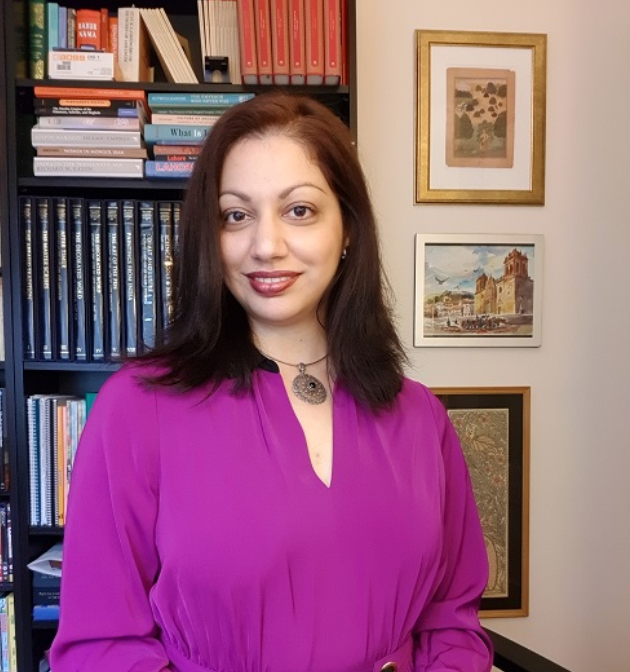
Dr Mehreen Chida-Razvi, India Travel Award 2015-16, for a visit to India for her study of imperial and royal Mughal patronage of architecture during the reign of Jahangir.
Dr Mehreen Chida-Razvi’s expertise is on the art, architecture, and material culture of Mughal South Asia. Her research areas include the intersection of art, architecture, and politics; the architectural patronage of the Empress Nur Jahan; the physical and cultural spaces occupied by women; and European views of the Mughal empire. Her work has centered on the artistic production of the reign of the 4th Mughal emperor, Jahangir (r.1605-27), and she is preparing a monograph on his mausoleum, located in Shahdara, Lahore.
Dr Chida-Razvi has published extensively on aspects of Mughal and Persianate art, architecture and urbanism. Her publications include: the chapters ‘Continuités: Regards croisés sur les arts moghols et sud-asiatique’; ‘Les residences princières, images de pouvoir et de prestige’; and ‘Les femmes dans la vie artistique moghole’ in Les Arts Moghols, eds. Corinne Lefèvre and Jean-Baptiste Clais (Paris: Citadelles & Mazenod, 2024); ‘Picturing the Mughal Madonna: The Virgin Mary as a Symbol of Mughal Legitimacy and Royal Authority in Jahangir’s Architecture’, in Mary, Mother of God: Devotion and Doctrine in the Visual Arts, 1450-1700, eds. Barbara Haeger, Elliott D. Wise, and James Clifton (Brill, 2024); ‘Power and Politics of Representation: Picturing Elite Women in Ilkhanid Painting’, in Mehreen Chida- Razvi, Alison Ohta & Emily Shovelton (eds.), ‘Lifting a Veil from the Face of Depiction’: Studies in Honour of Barbara Brend, Journal of the Royal Asiatic Society Special Issue (October 2022); ‘Mughal Governance, Mobility and Responding to the Plague in Agra, 1618-19’, in Epidemic Urbanism: How Contagious Diseases Have Shaped Global Cities, eds. Mohammad Gharipour and Caitlin DeClerq (Bristol, Intellect Publishing: 2021), 14-23; EPUB undefined pages; ‘Lahore’s Badshahi Masjid: Spatial interactions of the Sacred and the Secular’, in The Friday Mosque in the City: Liminality, Ritual, Politics, eds. Suzan Yalman and Ayse Hilal Ugurlu (Bristol: Intellect Publishing: December 2020); ‘Introduction: Resituating Mughal Architecture in the Persianate World: New Investigations and Analyses’ and ‘From Function to Form: Chini-khana in Safavid and Mughal Architecture’, in Mehreen Chida-Razvi (ed.) ‘Resituating Mughal Architecture in the Persianate World: New Investigations and Analyses’, Special Issue of the Journal of South Asian Studies, 35:1 (May 2019); ‘Patronage as Power, Power in Appropriation: Constructing Jahangir’s Mausoleum’, in The Mughal Empire from Jahangir to Shah Jahan: Politics, Art, Architecture, Law, Literature and Aftermath, eds. Ebba Koch, Ali Anooshahr and Robert McChesney (Mumbai: Marg, Jan 2019), 82-105; ‘A Sultan before the Padshah? Questioning the identification of the turbaned figure in Jahangir Preferring a Sufi Shaykh to Kings’, in Art, Trade and Culture in the Near East and India: From the Fatimids to the Mughals, eds. Alison Ohta, Michael Rogers, Rosalind Wade Haddon (London: The Ginko Library, 2016); ‘Where is ‘The Greatest city in the East’? The Mughal City of Lahore in European Travel Accounts between 1556 and 1648’, in The City in the Muslim World: Depictions by Western Travel Writers, eds. Mohammad Gharipour and Nilay Ozlu (Routledge, 2015), 79-100; and ‘The Perception of Reception: the Importance of Sir Thomas Roe at the Mughal Court of Jahangir,’ Journal of World History 25, June/September 2014.
Dr Chida-Razvi has shared her academic expertise with wider audiences through her participation and consultation for documentaries on the Taj Mahal; programming on BBC World Service Radio, BBC2 and BBC4; participation in the Lahore, Jaipur, and Heidelberg Literary Festivals; and as an expert lecturer on cultural tours.
She is a Research Associate in the Department of History of Art at SOAS, University of London, and an Associate Editor for the International Journal of Islamic Architecture. She regularly teaches courses and lectures on Islamic and Indo-Islamic art at universities and museums in London. She was named a Trustee of the Luigi & Laura Dallapiccola Foundation in 2020, and since 2012 has been the Hon. Secretary of the Indian Art Circle, a monthly lecture series on all aspects of South Asian art, held at SOAS.